
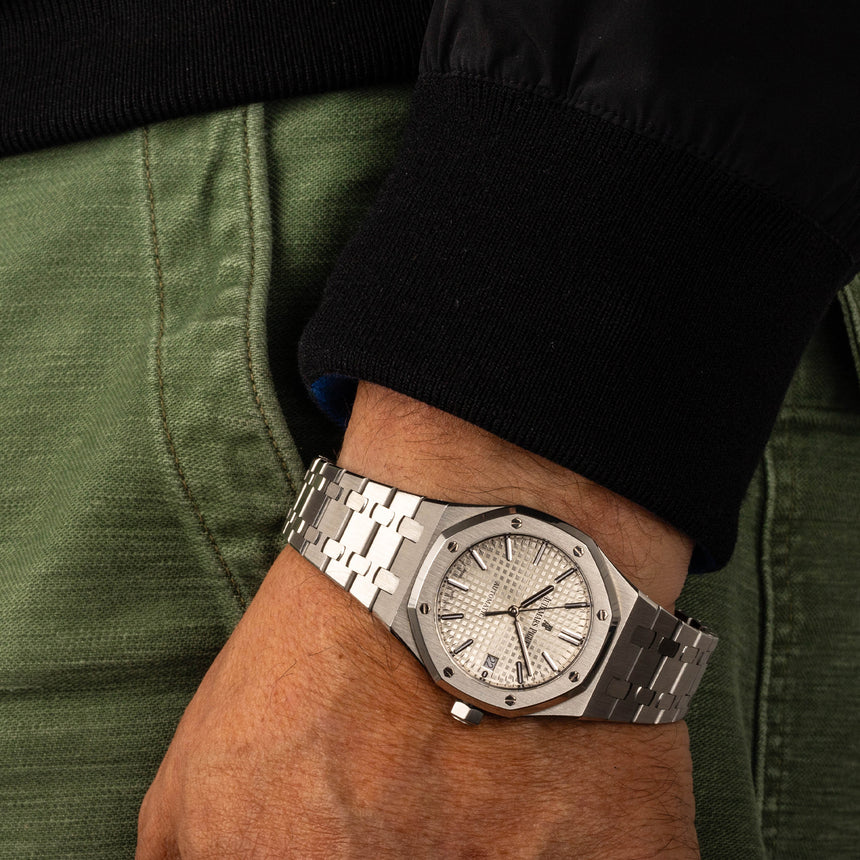
The Watch Sizing Guide: How to Choose the Right Watch Size for Your Wrist
Key Takeaways
- Watch size is determined by wrist circumference, not by gender or style preference. The correct watch diameter sits within 0.25 inches of the wrist width on both sides.
- Measure wrist circumference with a flexible tape measure. Use the circumference to determine the maximum lug-to-lug width that fits without overhang.
- A watch that is too large overhangs the wrist bone and looks unbalanced. A watch that is too small disappears on the wrist and looks like a bracelet.
- The style of the watch also matters. Sport watches can be slightly larger than dress watches. Dress watches should be as small as the movement allows.
Watch sizing is one of the most overlooked details in accessorizing, and it has a significant effect on how a watch looks and feels. A watch that is too large for the wrist looks like a bracelet on a stick. It overhangs the wrist bone, catches on clothing, and looks out of proportion. A watch that is too small disappears on the wrist and looks like a jewelry accessory rather than a timepiece. The correct size is determined by the wrist circumference, not by gender or style. A man with a 6-inch wrist needs a smaller watch than a woman with a 7-inch wrist. The sizing formula is based on the ratio of wrist circumference to watch diameter. A watch that has a diameter of 1.25 to 1.5 times the wrist circumference is proportionate. A watch that has a diameter larger than 1.5 times the wrist circumference is oversized. A watch that has a diameter smaller than 1 times the wrist circumference is undersized.
How to Measure Wrist Circumference
Wrist circumference is the circumference of the wrist at the point where the watch will sit. It is measured with a flexible tape measure or a piece of string and a ruler.
Step 1: Place the tape measure around the wrist at the wrist bone. The wrist bone is the bony prominence on the outside of the wrist, just below the hand. Do not measure at the forearm or at the base of the thumb.
Step 2: Pull the tape measure snugly but not tightly. It should be in contact with the skin all the way around but not compressing it. The measurement should be in inches or centimeters.
Step 3: Record the measurement. Wrist circumference ranges from 5.5 inches (14 cm) to 8 inches (20 cm) for most adults. The average is 6.5 to 7 inches (16.5 to 18 cm).
The Watch Sizing Formula
The sizing formula uses wrist circumference to determine the appropriate watch diameter and lug-to-lug width.
Watch diameter: The watch diameter should be 1.25 to 1.5 times the wrist circumference. For a 7-inch wrist, the ideal diameter is 34 to 40 millimeters. For a 6-inch wrist, the ideal diameter is 30 to 35 millimeters. For an 8-inch wrist, the ideal diameter is 38 to 45 millimeters.
Lug-to-lug width: The lug-to-lug width is the distance between the lugs, the metal bars that hold the strap. The lug-to-lug width should be less than or equal to the wrist circumference. For a 7-inch wrist, the maximum lug-to-lug width is 7 inches. Most watches have a lug-to-lug width of 4 to 5 inches. A lug-to-lug width that is larger than the wrist circumference causes the watch to overhang the wrist.
Case thickness: Case thickness is independent of wrist size but affects comfort. A thick case on a thin wrist looks bulky. A thin case on a thick wrist looks delicate. Choose a case thickness that is proportionate to the dial size. A 40mm dial looks better with a 10mm case than with a 15mm case.
Style and Size Relationship
The style of the watch affects the appropriate size. Dress watches can be smaller than sport watches because they are designed to sit close to the wrist and to be worn under a shirt cuff. Sport watches can be larger because they are designed to be seen and to have a strong presence.
Dress watches: 34 to 38 millimeters for most wrists. Smaller is better for dress watches because they are worn under shirt cuffs and should not interfere with the cuff movement.
Sport watches: 38 to 44 millimeters for most wrists. Sport watches can be larger because they are designed to be seen. A 42mm sport watch on a 7-inch wrist looks proportionate. A 42mm dress watch on a 7-inch wrist looks oversized.
Field and pilot watches: 38 to 42 millimeters. These watches are designed to be legible and durable. They can be slightly larger than dress watches.
Diver watches: 40 to 44 millimeters. Diver watches have thick cases and rotating bezels. They look better in larger sizes because the bezel and the dial are proportional to the case.
Watch Band Considerations
The watch band is as important as the case size. A watch with the right case size but the wrong band size will look uncomfortable and unbalanced.
Band length: The band should be long enough to fasten with the middle hole. A band that is too short can only be fastened on the first hole and feels tight. A band that is too long has excess tail that is either tucked in or hangs loose. Most bands come in standard lengths. For wrists smaller than 6.5 inches, a short band may be needed. For wrists larger than 8 inches, a long band may be needed.
Band width: The band width should match the lug width. If the lug width is 20mm, the band should be 20mm. A band that is wider than the lugs overhangs the case. A band that is narrower than the lugs leaves a gap.
Band material: Leather bands are traditional and versatile. Metal bands are durable and modern. NATO straps are casual and functional. Choose the band material based on the occasion and the outfit.
Frequently Asked Questions
Is a large watch more masculine?
No. Watch size is determined by wrist circumference, not gender. A large watch on a small wrist looks disproportionate regardless of gender.
Can I wear a 44mm watch on a 6.5-inch wrist?
You can, but it will look oversized. The lug-to-lug width will likely extend beyond the wrist bone on both sides. The watch will catch on clothing and look like a bracelet on a stick.
Do women''s watches have to be small?
No. Women with larger wrists can wear men''s watches. Many women''s watches are sized too small and look like jewelry rather than timepieces. If the sizing formula calls for a 38mm watch, buy a 38mm watch regardless of the marketing label.
How do I know if a watch fits before buying?
Try it on. If the lug-to-lug width overhangs the wrist bone by more than 0.25 inches on each side, the watch is too large. If the watch disappears behind the wrist bone, it is too small.
Watch sizing is a simple calculation that makes a significant difference in how a watch looks and feels. Measure the wrist, apply the formula, and choose a watch that fits. The right size looks intentional. The wrong size looks like a mistake.