
Why Your Part Line Is Burning and Peeling: The Scalp SPF Mistake Nobody Talks About
The scalp burns, peels, and flakes from UV exposure because most people never apply sunscreen along the part line or hairline. Powder SPFs and scalp mists now make daily coverage practical for every hair type.
Published
Marcus Vance
Fabric Longevity & Grooming Editor · Editor Bio → · How we research →
Bond-repair chemistry, wash temperature rules, and protein-moisture balance.
Key Takeaways
- The scalp is skin, and the part line and hairline are the most UV-exposed areas on the head.
- Daily sunscreen along the part is the single most effective anti-aging and skin-cancer prevention step most people skip.
- Standard liquid SPF can mat hair; powder and mist formats solve this without ruining a style.
- Hair dye, color-treated hair, and thinning hair are all more vulnerable to UV than intact, dense, virgin hair.
- A 30-second daily habit prevents the burn, the peel, and the long-term cumulative damage.
You applied sunscreen to your face, ears, and neck. You skipped the scalp. The part line and the hairline burned anyway, and two days later the skin started peeling in white flakes that looked like dandruff but were not. That is UV damage to skin, and it is the most preventable part of a daily routine.
The Scalp Is Skin, and It Burns
The skin on the scalp is structurally identical to the skin on your forehead. It has the same melanocytes, the same lipid barrier, and the same vulnerability to UV. The reason it does not burn as often is the hair covering it. Where the hair parts or recedes, the skin is fully exposed to the same UV that ages the face.
Three areas are most at risk:
- The part line. A direct channel for UV, especially on the crown and side part.
- The hairline and temples. Often exposed by hairstyles, hats off, and sweating.
- Any area of thinning or part wider than a few millimeters. The hair does not block enough UV to protect the scalp underneath.
The burn you feel in late summer and the peeling you see in fall are the same UV pathway, repeated across years. The cumulative effect is a meaningful risk factor for actinic keratosis and squamous cell carcinoma on the scalp, especially in men with thinning hair and women with center parts.
Why Standard Sunscreen Does Not Work on Most Hairstyles
The honest barrier: nobody wants to slick liquid SPF along a part line if it makes the hair greasy or changes the part. Most daily sunscreen formulas do exactly that. They leave a visible white cast on dark hair, weigh down the style, and re-trigger oil production on an already-oily scalp.
The result is that the people who most need scalp protection (those with thinning hair, color-treated hair, and fine hair) are the ones most likely to skip it.
The Scalp SPF Formats That Actually Work
The category has caught up. There are now three formats designed for hair without ruining a style.
- Powder SPF. A mineral powder brush-on that deposits zinc oxide or titanium dioxide along the part line. Brands like Supergoop (POOF), Colorescience, and Sharon Looney have made these. They disappear into the hair, set the part, and add grip.
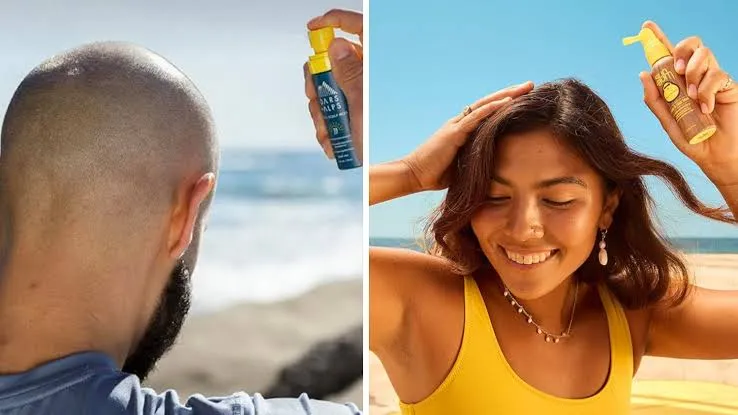
- Scalp mist or spray. A fine aerosol or pump spray that lays down a light SPF layer without flattening the hair. Brands like Coola, Lernberger Stafsing, and Briogeo have versions.
- Hair sunscreen cream. A lightweight, non-greasy cream applied with a finger along the part line. Works on thicker hair where powder would clump.
The active ingredient matters less than the format. Choose the one you will actually use daily.
A 30-Second Scalp SPF Habit
- After styling and before leaving the house, lift the part with two fingers.
- Run a powder brush or mist along the part line for 4 to 6 inches.
- Repeat on the other side and along the hairline.
- Reapply every 2 hours in direct sun, or after swimming or heavy sweating.
That is the entire routine. It is faster than brushing your teeth, and it prevents the burn and the peel.
Who Most Needs Scalp SPF
- Anyone with a visible part wider than 3 to 4 millimeters. UV reaches the skin directly.
- Thinning hair, male or female pattern. Every part exposes more skin.
- Color-treated hair. UV breaks down dye molecules and fades color within weeks.
- Anyone with a history of scalp sunburn or actinic keratosis. Cumulative damage is real, and the scalp is a common site.
- Outdoor workers and athletes. Cumulative daily exposure matters more than the occasional beach day.
Frequently Asked Questions
Is scalp SPF necessary if I wear a hat?
A UPF 50 hat covers most exposure. A baseball cap leaves the part line and ears exposed. If you wear a wide-brim hat, scalp SPF is redundant. If you wear a cap, scalp SPF is non-negotiable.
Will scalp SPF make my hair look greasy?
The right format will not. Powder and mist formats disappear into the hair. If you try a liquid SPF and it greases, switch formats. The barrier to compliance is format, not principle.
Does UV really fade hair color?
Yes. UV breaks down the chromophores in both permanent and semi-permanent dye. A scalp SPF along the part line, plus UV-protective hair products, can extend color by 2 to 4 weeks.
What about scalp SPF in winter?
UV is present year-round, and snow reflection intensifies exposure by up to 80 percent. A daily scalp SPF is a year-round habit, not a summer one.
Your part line burns and peels because the scalp is skin and you skipped the SPF. Add a powder brush or mist along the part daily, wear a hat for long outdoor exposure, and the burn, peel, and long-term damage stop.