
Why Your $80 Amazon LED Mask Doesn't Work: The Fake-Wavelength Problem
Cheap LED masks often list impressive wavelengths on the box but ship underpowered LEDs at the wrong nanometers, so light never reaches therapeutic dose. Checking irradiance specs separates real devices from glowing placebo.
Published · Updated
Sophia Chen
Senior Skincare & Ingredients Editor · Editor Bio → · How we research →
Medically Reviewed by Dr. Elena Rostova, MD
Medical & Dermatological Reviewer · MD, Board Certified in Dermatology · Clinical Research Fellow · Member, American Academy of Dermatology (AAD)
Our comprehensive library of ingredient breakdowns, product tests, and barrier protocols.
Key Takeaways
- Genuine at-home LED therapy depends on specific wavelengths (633 nm red, 830 nm near-infrared) at a therapeutic irradiance.
- Many discount masks list the right wavelengths on the box and ship underpowered or off-spec LEDs.
- A device without published irradiance in mW/cm² is almost never delivering a clinical dose.
- Verified devices (Omnilux, CurrentBody, Dr. Dennis Gross) publish specs and FDA-cleared labeling.
- If your mask came in unmarked packaging with no irradiance number, it is probably a placebo.
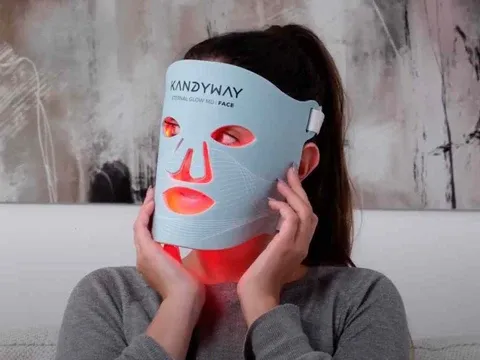
You bought a mask that promised clinical-grade red light for under $100. The LEDs light up. Your skin looks the same after three months. The mask is not broken. The mask is not even doing what its box claims.
What "Clinical-Grade" Actually Means
Photobiomodulation, the mechanism behind LED skincare, only works when three things line up:
- The right wavelength. Roughly 633 nm of red light reaches the dermis and stimulates fibroblasts. Around 830 nm of near-infrared penetrates deeper. Wavelengths in the 600 to 700 nm range without that precision scatter before they reach the target.
- Enough irradiance. Power density, measured in mW/cm², decides whether a session delivers a useful dose in 10 minutes. The clinical floor sits around 30 mW/cm². Most published at-home studies use 40 to 100 mW/cm².
- Enough time at that irradiance. Energy delivered equals irradiance times duration. Drop the power, and you have to sit under the mask for an hour to deliver the same energy a clinical device delivers in 10 minutes.
A mask that hits all three produces measurable change in 8 to 12 weeks. A mask that hits one or two is just glowing on your face.
How Cheap Masks Fake It
A recurring complaint on r/redlighttherapy and r/SkincareAddiction is not LED skepticism. It is LED fraud: "generic Amazon masks" that list no wavelength or irradiance specs, while brands like Omnilux and CurrentBody publish their numbers down to the nanometer.
Common shortcuts used in the budget category:
- Wrong-peak LEDs. A 620 nm LED looks identical to a 633 nm LED to the eye, but the difference in dermal penetration is meaningful. Some masks use 600 nm or 610 nm diodes because they are cheaper by the reel.
- Underdriven current. LEDs are often run well below their rated current to extend battery life. The light looks bright, but the actual photon output at the skin is a fraction of what the spec sheet claims.
- No diffusers. Clinical masks use optical diffusers to spread light evenly across the skin. Cheap masks let the LEDs shine like flashlights, so most of the photons never make it past the first millimeter of tissue.
- Sticker-only wavelength claims. A box that says "633 nm + 830 nm" with no irradiance number is decoration. The inside of the device may have a single 630 nm LED running at 5 mW/cm².
The Specs You Must See Before You Buy
If the listing does not show all four, walk away.
- Wavelength in nanometers. Look for 633 ± 10 nm red, 830 ± 10 nm near-infrared. Anything broader is marketing.
- Irradiance in mW/cm². Anything under 20 mW/cm² is decorative. Clinical home devices cluster around 30 to 60 mW/cm².
- Total optical power or J/cm² per session. This is the dose you actually receive. It should be published.
- FDA clearance or CE marking with a notified body number. Self-declared CE is a sticker. A notified body number is accountability.
When the Cheap Mask Is Fine
A cheap mask is reasonable if you only want gentle red light for mood, a bit of warmth, or as a habit anchor for a routine. It is not reasonable as an anti-aging tool. The dose will never reach the threshold where collagen synthesis is measurable.
Frequently Asked Questions
My cheap mask has hundreds of LEDs. Doesn't more LEDs mean more power?
Not necessarily. LED count without irradiance is a decoration metric. A 200-LED array underdriven at 5 mW/cm² delivers less energy than a 100-LED array run at 30 mW/cm².
Is Omnilux or CurrentBody worth the price?
Both publish their irradiance and wavelength specs and have FDA clearance. A common view on Reddit is that consistent users see results and inconsistent users do not. The mask is a tool, not a treatment.
Can I make a cheap mask work by wearing it longer?
No. Photobiomodulation has a dose ceiling. Past roughly 20 J/cm² per session, additional light adds no benefit and can irritate. Doubling the time on an underpowered mask gets you closer to the dose but at the cost of heat and compliance.
How do I test if my current mask works?
You cannot, at home, without a calibrated light meter. The honest test is 12 weeks of consistent use at the manufacturer's recommended time, comparing standardized photos. If nothing changes, the device is the variable.
Your $80 mask does not work because cheap LEDs run at off-spec wavelengths and underpowered currents, so the dose never reaches the threshold where skin responds. Buy a device that publishes its numbers, or accept that you own a glowing placebo.